

 August 20, 2026
 Executive Desks 2026: The Ultimate Online Buying Guide
Summary: This guide covers all that is required for purchasing the perfect executive desk in 2026, including various styles, sizes of executive desks, materials used in making such desks, costs, and even how to select an executive desk according to the job and the room space. The last part of the guide includes questions and a checklist for potential purchasers.
Buying Guide for Executive Desks in 2026
Executive Office Furniture | Executive Desk Dimensions | Work Desk
The guide will provide all the information that you should be aware of before making your purchase – the types of desks, their possible sizes, materials used, and costs. The guide will tell you what desks would be appropriate for you depending on the space and budget. Whether you need one executive desk for a single office or multiple workstations for an entire floor, this checklist will help you choose the right one.
What is an Executive Desk?
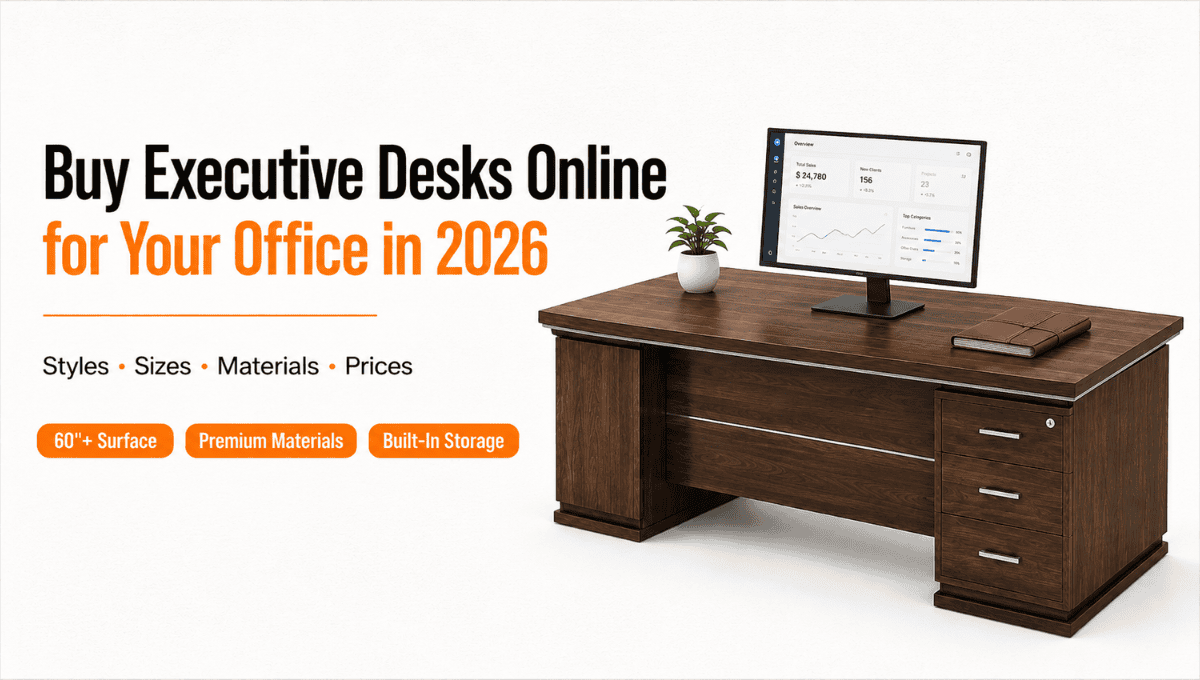
Top managers, company owners, and professionals use executive desks because their large, impressive design creates an image of power, stability, and authority, especially in offices where they meet clients.

Executive desks typically include:
- Work surface area that is larger than 60 inches or more
- Storage drawers and cabinets
- Fine finishes, including wood veneer, laminate, glass, or metal finishes
- Another similar piece of new office furniture to complement the whole look of the room
Executive Desk Styles: Which One Fits Your Office?
It should be understood that not every leader requires the same desk. The CEO could require a bold and classic desk, while the entrepreneur would probably want a modern one – it all depends on many things. The table below highlights some of the differences between the various types of office desks, so you will have a better idea of what you need.
1. Classic Desk (Traditional Executive Desk)
The classic desk is what usually comes to mind when people think about “executive office furniture” — the kind that has either a hardwood or wood veneer structure with sides made out of panels. The best choice for law offices, finance-related offices, and other corporate settings in need of executive office furniture.
2. Modern Desk
A modern desk is all about keeping things straightforward – clean design, lightweight appearance, and the use of materials such as glass, metal, and matte laminate rather than cumbersome wood. It remains professional yet without being traditional and bulky. This is why it is loved by startups, advertising companies, and IT companies.
3. L-Shaped Executive Desk
With an L-shaped desk, one can benefit from the additional feature of a return, which provides a perpendicularly positioned extension that almost doubles the surface area. This kind of desk is ideal for an executive who needs to have a desk where he/she can work on the computer and also accommodate the paperwork. The L-shaped executive desk offers good value for money.
4. Corner Desks
The corner desk can be said to be a smaller form of the L-shaped desk. The reason is that it is created in such a way that it can be placed in a corner, therefore making good use of the available floor space. It thus makes an excellent office desk for smaller executive/home office spaces.
5. Standing Desks & Height-Adjustable Desks
Executive standing desks were once considered a bit eccentric and were only found in tech office environments; however, they are increasingly becoming mainstream in executive office settings. The executive standing desk is still elegant in its appearance, but it has an additional feature of having a lift that can be either motorized or manually operated. This allows one to easily adjust the height of the desk according to whether they want to sit or stand.
6. Table Desk
Others prefer a table desk that consists only of legs and a top, without drawers embedded in it. This type of desk can be found as a center desk in an open space for leaders/offices. To put it differently, this may be viewed as a more compact form of the executive desk.
Size of an Executive Desk: Which One to Choose?
Size selection happens at the shop to be the biggest mistake made by individuals when purchasing an executive desk. An executive desk that may seem like the perfect size in the image may not turn out to be that way after it has been delivered to you.
Standard Size Guide
| Desk Type | Typical Width | Typical Depth | Best For |
| Small desk | 40–48 in | 24 in | Compact offices, secondary staff |
| Standard executive desk | 60–66 in | 30 in | Most private offices |
| Large executive desk | 66–72+ in | 30–36 in | C-suite, corner offices |
| L-shaped desk | 60–72 in (main) + 42–48 in (return) | 24–30 in | Multi-task executive work |
| Front desk / reception desk | 48–72 in | 24–30 in | Lobbies, reception areas |
Determining the Right Desk for the Room
- Keep a minimum distance of 36 inches behind the desk, which will be sufficient for sitting in a chair and moving around easily.
- If you have an L-shaped desk or a corner desk, do not only measure the surface but the complete area. There is an additional piece on the desk that makes the L-shape. It will definitely be bigger than what you think.
- An expansive executive desk that is 66 inches or more is perfect for use in a large office, but an excessively large desk in a small office is uncomfortable because it takes up too much space.
Executive Desk Materials & Construction
The following is a summary of information that relates to the materials and workmanship quality of this desk. This table presents the specifications of each desk component, which manufacturers carefully select to ensure durability and a professional appearance.

- Wooden desk: The traditional material used to make traditional desks. The solid wood choice is costly and will last many years, while veneer laid over engineered wood produces the same result for less money.
- Laminate: Being cost-effective and durable in nature, this material is available in wood and other variants as well. Manufacturers mostly use this material to build mid-range office and work desks.
- Glass and metal: These materials are used in contemporary desks and minimalist table desks. These are lightweight materials and have an elegant appearance, but they can scratch, smear, or get dirty easily. Therefore, these require a bit more maintenance than other desk materials.
- Engineered wood with a metal frame: Manufacturers commonly use this combination in lifting and standing desks because it supports the height-adjustable frame while keeping the desk sturdy and stable at any position.
Storage: Desk With Drawers vs. Simple Desk
One major variation in executive desks has to do with storage. There are those that come with many drawers and cabinets, while there are some without storage space at all. It all boils down to personal preference.

A desk with drawers is the standard for most executive office desks and includes:
- 2–3 box drawers for stationery and small items
- 1–2 file drawers sized for letter or legal hanging folders
- Sometimes, a locked drawer for confidential documents
Simple desk (no or minimal storage) suits:
- Executives who use a separate credenza or filing cabinet
- Modern desk and office table desk setups prioritizing an open, minimal look
- Use shared workstation desks when you keep storage in a separate, centralized area.
A desk with drawers is the best choice for offices that have lots of papers, while in the case of an all-digital working environment, a desk without drawers is a good choice.
What is the Price for an Executive Desk?
Prices of executive desks may differ a lot based on size, material used, and many other factors. Check out the cost of an executive desk in 2026.
| Category | Approximate Price Ranges | What You Get |
| Small desk / basic work desk | $150–$400 | Laminate, minimal storage, compact footprint |
| Mid-range executive office desk | $400–$1,200 | Solid construction, drawers, wood-look finish |
| I-shaped executive desk | $600–$2,000 | Larger surface, return, more storage |
| Large executive desk (Best wood) | $1,500–$5,000+ | Solid wood or quality veneer construction |
| Executive standing desk / height adjustable | $500–$2,500 | Motorized or manual lift, premium finish options |
| Front desk / reception desk | $500–$3,000 | Custom branding options, durable high-traffic build |
Tip: Don’t buy on price alone. A desk that’s $200 cheaper but wobbles within a year or doesn’t fit your office layout costs more in replacement and downtime than the upfront savings.
New Office Furniture – Full Office Fit-Out
Instead of opting for only one executive desk when you are outfitting several rooms, think about incorporating other complementary furniture items like cabinets, shelves, or conference tables. The coordination of furniture in relation to materials, finishes, and design is important to create an overall consistency in the room.

- Front desk: The front desk needs to be firm and inviting – constructed of robust materials that will last for a long time and give off a professional vibe. The desk should also reflect the company’s brand identity by using the right colors and logo, helping employees and clients recognize the brand.
- Center table: The central table must be able to support daily objects such as beverages, documents, and laptops without tipping or damaging these items. In addition, the central table should be proportionate to the furniture surrounding it to create a proper look for the entire sitting arrangement. The table cannot be too large or too small.
- Workstation desk: The workstation desk is intended for the use of support staff and is generally more compact compared to an executive desk. It needs to be practical and functional and offer adequate space for daily activities such as operating the computer, organizing files, and papers without having any additional frills that add no value to its function.
- Office desks: Office desks are used by regular team members, not leadership, and are designed to be the same across the workspace. The main focus is on saving costs and keeping a uniform look, so all desks match and work well together. They are simple and functional, giving employees enough space for daily tasks without extra features.
Office furniture that matches will always ensure uniformity within the office. This also means that when you purchase office furniture as a package deal, you will save some money because some suppliers will give you a bulk discount on many items at once..
How to Choose the Right Executive Desk: A 4-Step Checklist
Choosing the right executive desk involves more than just picking a style you like — it requires careful consideration of several practical factors. Follow this simple 4-step checklist to make a confident and informed decision.

- Measure your room first. Note the doorway width too — large executive desks sometimes don’t fit through standard office doors in one piece.
- Select the right type of furniture depending on your brand. Although a classical desk will fit the law firm, a modern one will fit well with the start-up. Using the wrong furniture will defeat the purpose of the image you want to create.
- Think about ergonomics. In case the executives spend much time sitting at their desks, a standing desk is definitely a good investment in their well-being and concentration.
- Determine the reasonable price range according to the table of prices above, paying more attention to quality than to extras.
Picking an executive desk isn’t just about looks — it’s about getting a desk that works for you every day and gives your office a professional feel.
Why Crafted Furniture is the Right Choice for Executive Desks
At Crafted Furniture, we make and customize executive desks for home offices, companies, and client meeting spaces. Whether you want a classic executive desk, one that adjusts in height, or a premium table for a boardroom or leadership office, we build it around what you actually need — not just how it looks.
Every workspace is different. That’s why we help you pick the right size, material, and style for your room, your role, and your daily work — whether it’s one desk for a home office or matching desks for a whole office floor. We also take care of the small but important details — cable management, how much weight the desk can hold, drawer quality, and the right height — so your desk stays strong and useful for years.
Concluding Remarks
You can easily use all the criteria mentioned above to compare different options. One should keep in mind that an executive desk is not necessarily the largest and the costliest piece of furniture, but the one that meets the requirements concerning the space and the desired impression of the office.
Contact us now to discover the perfect executive desk for you.
FAQs
What is the standard size of an executive desk?
Most executive desks range from 60 to 72 inches wide and 30 inches deep. Larger executive offices often use desks at the top of that range (66–72 inches), while smaller offices are better suited to 48–60-inch models.
What's the difference between an executive desk and a regular office desk?
An executive desk is larger, uses higher-end materials (solid wood, premium veneer, or glass), and typically includes more built-in storage than a standard office desk. Regular office desks prioritize cost efficiency and are sized for individual workstations rather than leadership presence.
Are standing desks suitable as executive desks?
Yes. An executive standing desk looks upscale but can also adjust in height—so you get the classic executive look plus the option to switch between sitting and standing. By 2026, most of these desks will come in both traditional and modern styles.
